What started as a simple project evolved into some light engineering. We have a magnetic control device – let’s say it’s an electronic equivalent of a reed switch. It outputs +12 VDC when inactive and is floating when activated. Next, we have a control device with two pins – one is connected to ground (GND), while the other expects to be connected to ground to know that something has happened. The task is simple: connect these two devices so that when the magnetic switch outputs +12 VDC, the control device receives GND and knows that something has happened. And there is one additional requirement – the circuit should consume no current, or at least veeeery little current, because it might be running from a battery. At first, I thought about using a relay. Easy peasy – converting +12 V to GND with a relay is trivial. But the relay would consume about 100 mA while energized. Can we go lower? We could use an optocoupler, but it has an LED that would consume some current:
So about 5 mA. That’s already 20 times less, but can we go even lower? It seems we can. We could take small NPN transistor, for example BC847, to do the job. Lets try to draw preliminary schematics:
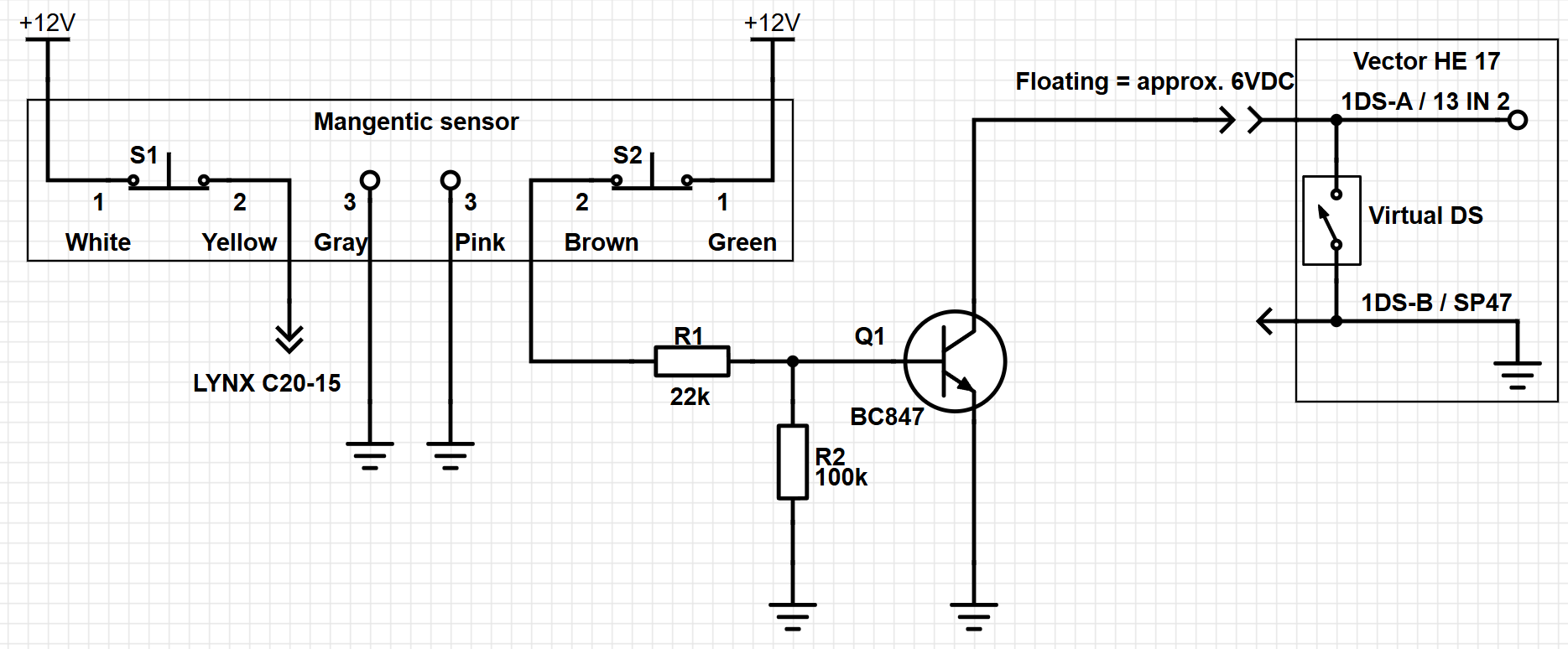
R1 – to control transistor base current, R2 – to make sure transistor is closed when S2 is open. Current through Virtual DS is only 0,4833 mA, so even smallest transistor would easily survive, not even mentioning, that BC847 can withstand 100 mA, so ~200 times more. Resistor values in schematics I inserted, because first calculated them and writing this article afterwards .
That means transistor control option would use 0,5 mA, that is 10 times less than optocoupler and 200 times less than relay. I think I cal live with such current consumption. Transistor is very small, SMD type, SOT-23 housing – not always good to be so small. Bigger substitute can be BC547, TO-92 housing.
That is only basic idea, I would add TVS diode on transistor base.